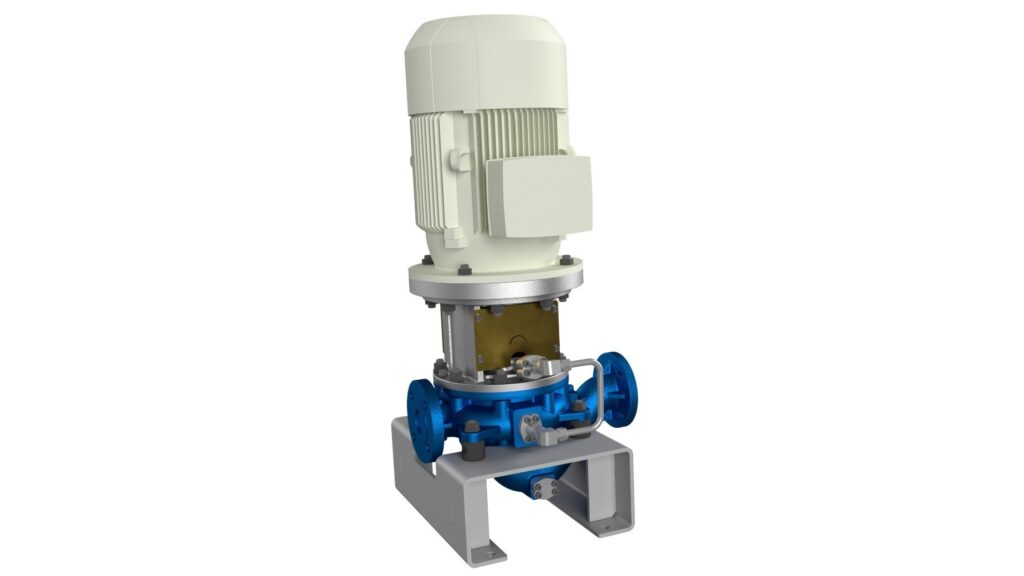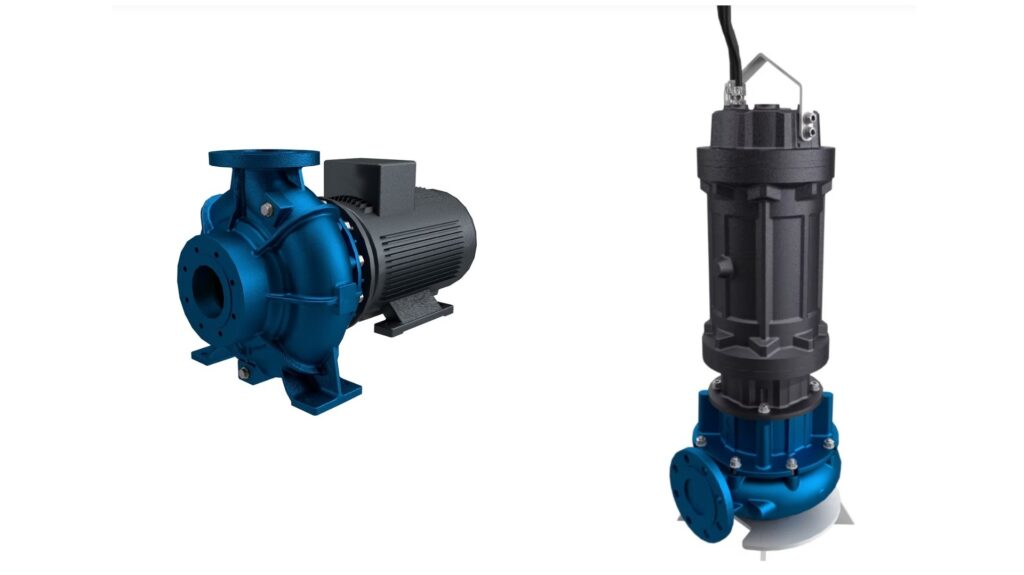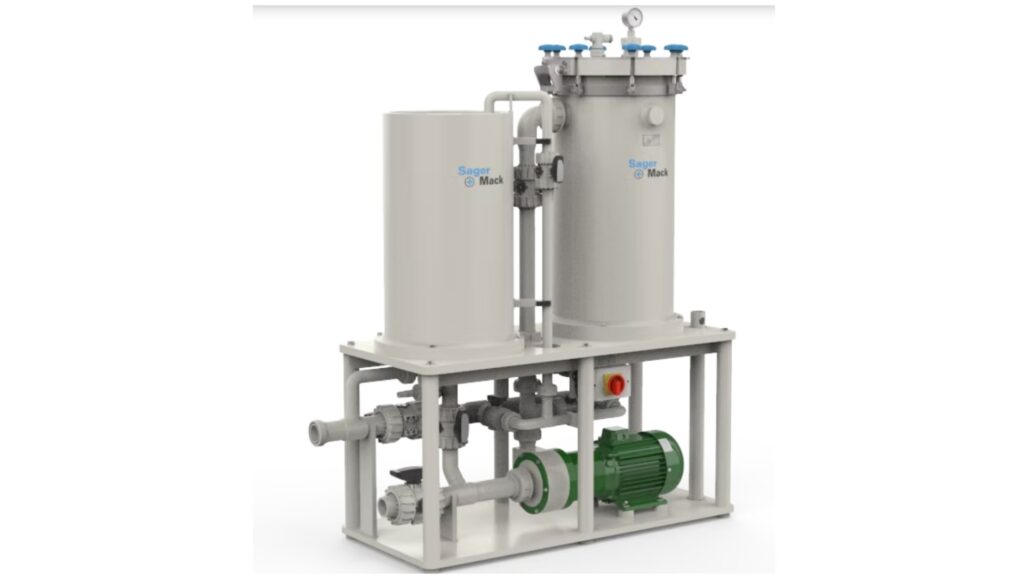
Immersion pumps are single-stage, end-suction centrifugal pumps with axial inlet. They are installed vertically, with the pump head submerged in the fluid while the motor remains dry. The models developed by Sager + Mack are made from high-quality plastic (PP/PVDF) or stainless steel (V4A) and are known for their excellent corrosion resistance, smooth operation, and high reliability. The pump head features welded connections (flange, thread, or hose fitting), and the special tubular impeller is mounted on a non-wetted stainless steel shaft.
For immersion depths up to 400 mm, the shaft is supported only in the dry area. From 400 to 600 mm, an additional fluid-lubricated slide bearing made of silicon carbide (SiC) is used. The open suction port is optimized for flow and avoids NPSH-limiting resistances. The discharge side is routed above the liquid level via a fixed riser pipe.
The fluid enters axially and is accelerated by the rotating impeller, which conveys it to the discharge side. Flow rate and pressure depend on impeller geometry, system losses, and pump performance, and can be adjusted via speed control or bypass options. Typical performance data: pressure up to 6 bar, flow rates up to 120 m³/h, viscosities up to 100 mPas, temperatures from 5–95 °C (plastic) or 0–120 °C (stainless steel), and motor power from 0.8 to 9.2 kW. Solids content up to 25% is possible, depending on the medium and pump size. Maximum immersion depth without extension is 600 mm.
These pumps are used as transfer or circulation pumps, especially for aggressive or environmentally hazardous media such as acids, alkalis, chemicals, or contaminated wastewater. They are typically mounted on tanks or in sumps equipped with level control.
The shaft-to-motor transition is sealed externally with a labyrinth seal, which can be designed in a gas-tight version (not TA-Luft compliant). All wetted parts are corrosion-resistant and matched to the medium, including appropriate sealing materials.